Wednesday, May 21, 2014

Musings

I have recently been thinking about what a rich and powerful word “muse” is  


The Muses, daughters of Zeus and Mnemosyne, were Greek goddesses of inspiration in the realms of literature, science, and the arts.  Originally there were only three Muses, embodying song, practice, and memory, but the number eventually expanded to nine to further personify literary and artistic wisdom.  Poets in Ancient Greece would invoke a Muse or Muses for assistance and insight, essentially seeking to become channels for them to sing through.  One of the most well known examples of this is when Homer calls upon the Muse to ask for help in telling the story of the hero in The Odyssey, saying: 

“Sing to me of the man, Muse, the man of twists and turns
driven time and again off course, once he had plundered
the hallowed heights of Troy." 

(Robert Fagles translation, 1996)

The etymology of the word muse is fascinating in and of itself.  “Muse” comes from the Ancient Greek “Μοῦσαι.”  Not only does it identify the goddesses of inspiration, but in a broader sense has also become a way to refer to someone--or something--that inspires.  By the Renaissance, a muse could be an artist’s favorite model or even lover, a title we still make use of today to describe the motivating qualities of a significant other.  

As a verb, to “muse” is to be absorbed in thought or to deeply consider. To “amuse” someone is to divert their attention, entertain them, and/or cause them to muse.  Amusement typically inspires laughter and mirth.  “Bemused” is similar in implying an aspect of thoughtfulness, but usually inspiring it with a more puzzled or bewildered sense.

“Muse” is also the root of words relating to or describing some function of the arts.  While it has become solely used to identify the production of harmonious sounds, the word “music” is derived from mousa, and in Ancient Greek “mousike” meant any of the arts related to the Muses.  And of course, a museum is a literal “house the Muses”.

Lee Siegel wrote an excellent piece in The Wall Street Journal in reference to a 2009 MET exhibition entitled “The Model as Muse”.  In it he discusses the evolution of the muse throughout history, from Ancient Greek goddesses to modern day pop icons.  He also questions the current status of the artist/muse relationship, asking “Who, in our proudly individualistic culture, wants to feel like a valet to someone else's imagination?” He touches on some great ideas, and it seems to me that the article points to a larger issue taking place within the contemporary art world, namely that we have forgotten the value of the muse in today’s art.

I've always felt that Spell, an image I made in 1986, depicts a figure being guided by an 
unconscious force- perhaps intuition, and/or the muse.

When the Ancient Greek poets sought to become a channel for the Muse, they were seeking truth beyond what they were capable of consciously suggesting by conjuring it from one or all of nine personified goddesses of artistic inspiration.  This seems to me a stark contrast to many of today’s artists, where ego has come to play a much larger role in creating works of art.  Instead of reaching to a higher level of truth, much art today serves to express the artist’s personal feelings, thoughts or political views.  The art that is celebrated nowadays seems also to have shifted to the ironic and the conceptual-“Con Art,” as art critic Julian Spalding refers to it.  We are no longer seeking higher human truths that connect us to one another, ourselves, and our humanity, favoring instead the witty and the clever.  Many museums featuring much of contemporary art no longer have the magnificent quality of "housing the muses", instead highlighting work that is often alienating and isolating.  Perhaps the role of the museum has changed over the last several decades, from showing work that is inspired or inspiring to documenting the latest art star and the ever changing fashion of art.  Truly challenging art seems to have been replaced by work that is either excessively innocuous or shocking and sensational--very different ends of the same shallow spectrum and equally uninspired.  

I think there are many reasons for this shift in values and the loss of the muse. 

As an artist, teacher, and funder of the arts, I’ve come to see the contemporary art world from several perspectives and it has given me a unique point of view into some of these areas that I see as problems within it.   I'd love to have the opportunity to open up a dialogue about some of these issues and share further musings on the rich and complex world of art.

Tuesday, May 6, 2014

2014 Summer Workshops

Every year, I look forward to a handful of workshops that I teach throughout the summer.  This year I'm thrilled to be continuing work with two of my favorites workshops:  The Fine Arts Work Center in Provincetown, MA and the Maine Media Workshops in Rockport, ME.  As I gear up for these fabulous courses, I'm looking back on some of my previous experiences teaching the wonderful students I've had.


The Fine Arts Work Center:

As with many of the other classes I teach, Creativity, Intuition, and Seeing is centered around an intuitive approach to photography and the creative process.   We are taught our whole lives to think things through, be in control, and act with reason rather than intuition, but that approach limits our vision to see just what we expect to see, not what is actually in front of us.  Through exercises, assignments, and discussions, the goal of the workshop is to learn to use the camera as a tool for exploration, and to discover new ways of looking at and experiencing the world around us.

The last students I worked with at FAWC were just incredible, and really managed to grasp what it means to photograph through an intuitive visual process.  Here is just a small selection of some of their outstanding work:

Howard Rubin

Binney Wells

Dreyden Hebb

Laura Ward

Margaret Zaleski

_

Creativity, Intuition, and Seeing is just around the corner and runs from July 20 - July 25 at The Fine Arts Work Center at 24 Pearl Street, Provincetown MA 02657 


The Maine Media Workshops:

The Human Form is a class that is near and dear to my heart.  The body can be a classical and provocative subject, seen in one instance as graceful and alluring while challenging and provocative in another.  It has been an inspiration for artistic expression for centuries, and through working with it as subject matter has the potential to explore assumptions of beauty, our understanding of “self” and humanity, and the mysterious dynamics between body and spirit, body and mind.  Similar to my class at FAWC, The Human Form is a class that encourages an intuitive approach to working with this wonderful subject as a means to challenge the typical framework with which we make sense of the body.  The work my students have produced throughout the course of the workshop is always astounding, with everyone creating images that are unique and liberating for such a profoundly popular subject.  Here are some of the photographs from my 2013 MMW class:    


Mark Harris

Amber Laurent

Charlie Lemay

Enrique Monasterio

Ruth Steinberg

Harry Ulmen
_

The Human Body is taught when the weather in Maine is GORGEOUS, from August 17 - August 23, at The Maine Media Workshops, 70 Camden St, Rockport ME 04856

Thursday, December 19, 2013

The Science of Color Underwater

Working with both underwater and above water elements, there is a considerable color difference.

Generally speaking, color is perceived by the light that is reflected off of and/or absorbed by an object.  Color is interpreted by receptors in our eyes, and varies depending on the light’s wavelength (measured in nanometers, or “nm”).  Light with a wavelength of around 700nm is perceived as red, for example, while a wavelength of around 400 nm would be interpreted as violet.  The colors of the visible light spectrum are red, orange, yellow green, blue, indigo, and violet.

Excellent llustration of color absorption under water from
www.makewoodenlures.com
Due to the way that water absorbs light, there is a loss of perceived color when photographing underwater.  The longer the lights wavelength frequency, the easier it is absorbed by the density of water.  As depth and distance increase underwater, the harder it is for light to travel through.  In addition to getting darker, color too begins to fade, beginning with the red end of the visible light spectrum and followed by orange, green, blue, etc.  (An interesting point: While there is a point that the transmittance of color reaches absolute zero and none can be perceived, you could use something like a red filter and a longer exposure to filter out the blue light and give more time for light towards the red end of the spectrum to be detected.)

When we can simultaneously see light reflecting off an object- in this case, a figure- that is both inside and outside of water, the color shift is unmistakeable.  In every day seeing, we may take this dramatic change in color for granted as we are used to perceiving it that way, but to be able to examine the difference in a still, two dimensional image can be an entirely different experience.  I photographed under water for 14 years and never consciously noticed this remarkable color difference until seeing the images after those initial shoots in color.  I'd spent years integrating the three layers I'd become aware of- above the water, below the water, and the reflection on the surface of the water.  Shooting in B&W, I was always focused on the forms and relationships I was seeing happening within those three layers.  In working with the natural phenomenon of how water absorbs light, I found a fascinating fourth layer. 
Untitled #4-24-08-492


I discovered, quite by accident, that I could exaggerate the disparity of how things appeared above and below the surface of the water.  By lighting the portions of the body that are outside the water with warmer, natural light, while illuminating the submerged portions with a cooler, bluer underwater strobe, the passage from above to below became extraordinarily distinct.  The boundary between above and below water became charged, creating fascinating transitions and bizarre transformations.  [Since the strobe only illuminates what is under the water, there is also a significant exposure difference between what is above and below the surface.  By considerably slowing the shutter speed, the body above the water becomes soft due to the motion blur, while the strobe freezes the body underwater into sharp focus.  This differentiation can give the body outside the water an ethereal, flame-like feel that contrasts with the hardened, cold, stone-like feel of the body underneath, like in this image from 2009:

Untitled #06-10-09-189

In this image, the shutter speed is so slow and the exposure is so long that the warm light above the water manages to illuminate the body just barely below the surface.  You can see how the strobe has sharpened the right side of his face that is submerged in the water, making it both sharp and much bluer in hue.

I find all of this- and the science behind it- just incredible and truly fascinating.  I had no idea these dramatic effects of light and color were happening right before my eyes for so long, and the discovery of them reinvigorated the intrigue I've always had for working with this subject matter. 


Wednesday, December 4, 2013

Masks, Old and New

Photographed on a trip to Bhutan in 1978 
The mask has been used throughout history not only as a way to disguise oneself but a means to project a different persona.  Early cultures and civilizations used masks in sacred ceremonies as a means of channeling spirits and/or gods.  Ancient Greeks introduced masks into theatrical productions to hide the individual and personify their character.  Masks continued to be used in miracle, morality, and mystery plays throughout the Middle Ages, as well as in sacred dramas in Tibet.  Today, party goers at cultural events like Mardi Gras and Carnival become unencumbered by their typical inhibitions behind the guise of their masks, and protesters have made use of the Guy Fawkes mask from the movie "V for Vendetta" as a symbol of opposition and anti-establishment.

Psychologically, we hide behind masks every day; in the way we present ourselves to the world, act in certain situations, and conduct ourselves within a given environment.  We may use masks to hide our deepest, darkest fears, or we may use them to reveal our truer, inner selves.  Oscar Wilde said "Man is least himself when he talks in his own person, give him a mask and he will tell the truth". 


I've always been fascinated by the powerful symbols that masks can be, and the phenomenon of transforming oneself with a mask.  The theme of the mask has been consistent throughout my work from very early on.  From a very early age, I had struggled with identity issues.  I was confronted with the realization that I loved other girls at age 11, at a time when the masses considered homosexuality a perversion, and was wrecked with feelings of being an outsider.  I feared I was a pervert, a freak, and an outcast.  Fearing I was destined to be lonely and unfulfilled for the rest of my life, I vowed to hide my true self and my secret at all costs.  

Then in 1972, as a young student at MICA, I had created this self-portrait:


I had been experimenting in the darkroom by cutting, scratching, and burning negatives.  For this image, I cut the negative in half, put it in the enlarger, and projected it onto photographic paper.  The little Connie inside the split was a cut-out face of me from a different negative that I put directly on the photographic paper during the exposure.  By cutting the negative, I inadvertently cut the symbol of my facade or public mask in half to reveal the little Connie that had been stored away.

It wasn't my intention to make an image that made a revealing statement about myself or my secrets, I was simply playing and experimenting.  It took me years to even grasp the full significance of what this image meant.  Although it was technically crude, this was the first time that I used the symbol of a mask.  Throughout the course of my work, the archetypal symbolism of masks have re-emerged again and again, sometimes in the water:


But more often, and more reminiscent of the early cut negative self-portrait, in the mirrors:


I've been thinking about this recently because one of the latest images shot in the mirrors has a very strong feeling of a figure removing a mask:


I love the gesture in this image- the way she seems to be holding the mask as if just revealing her confident and clear self beneath.  The mask is almost ephemeral, even though she clearly has a grasp on it, and I love how it has the feeling of a full face masquerade type mask.  There's a sort of twisted elegance about her figure, and the way she has exposed her true self feels very natural, despite the overall bizarre quality of the image.

Whenever the appearance of masks have come up in my work,  it is always in the form of layers, both visually and symbolically.  I've often interpreted them as conveying psychological layers, representing conscious and unconscious elements, revealing deeper levels of understanding and awareness.  Carl Jung said that "the persona [mask] is that which in reality one is not, but which oneself as well as others think one is".  In many of these images, I see layers of the psyche being either exposed or hidden, the persona being projected or revealed through the presence or removal of the mask.  Continuing to work intuitively, it is always exciting to see common threads like this resurface in my work throughout the years... 


Tuesday, November 19, 2013

FOTO, October 2013

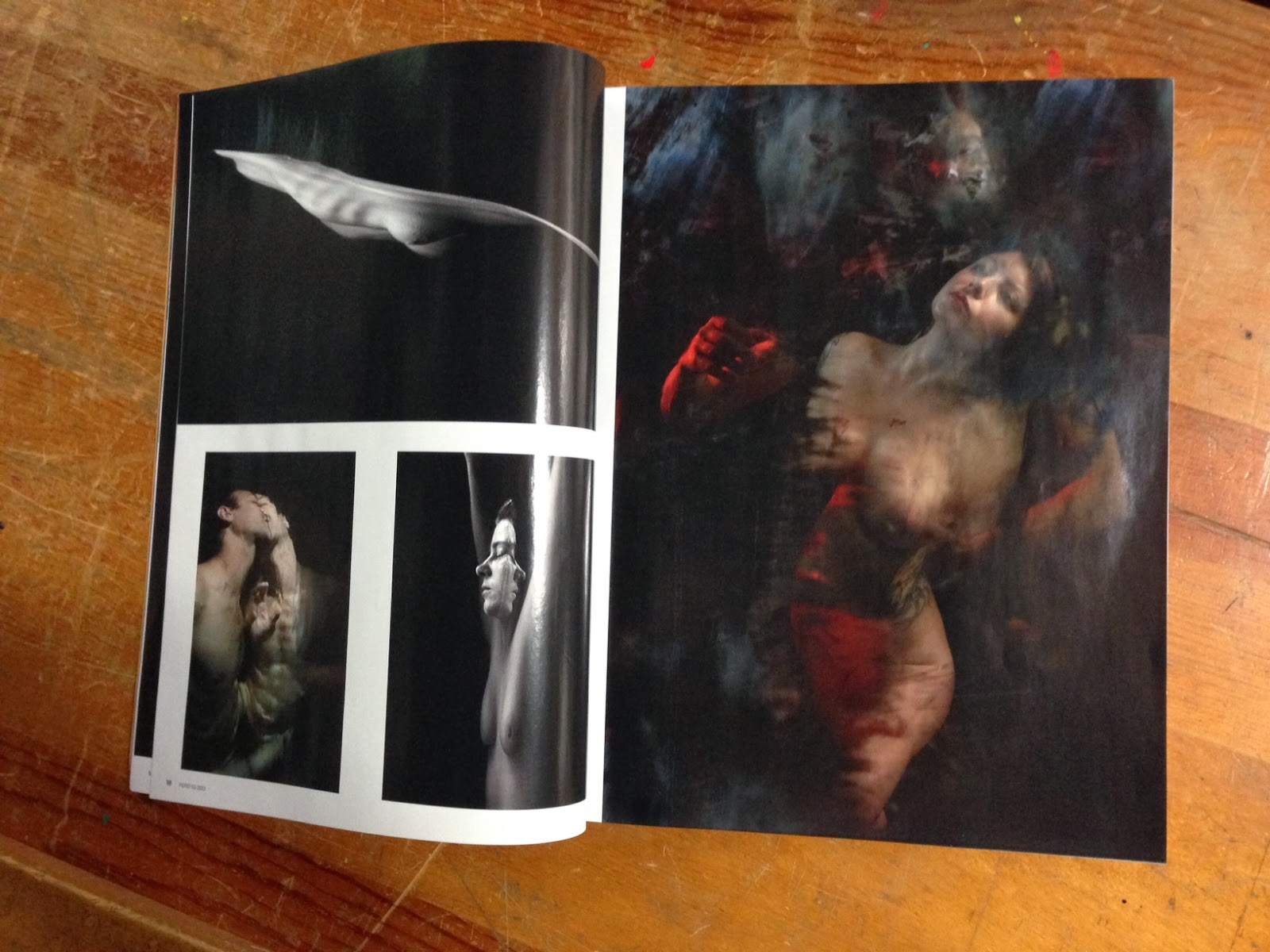
After my lecture and exhibit in Norway for the Nordic Light International Festival of Photography, I was approached by a Swedish photography publication called FOTO.  My work was very well received at the festival, and the magazine wanted to highlight my work with a portfolio spread and article to be featured in the October 2013 issue.  I just received a copy of the issue in the mail recently, and it looks fantastic:


The reproductions in the article are not only extensive, but the quality is outstanding.  I was really impressed with how well both the black & white and color images printed.


The piece is called "Connie Imboden: Reflections of Man", and opens with one of the more startling and daring images from my portfolio.  It also shows a picture of me in front of the pool, with an arrow pointing to "Den svartmålade poolen" ("The black-painted pool"):


The text reads: 
"Det finns en röd tråd i Connie Imbodens arbete.  Ett tema som föddes ur en stark rädsla för vatten i kombination med en fascination för människokroppen. Nu är rädslan försvunnen.  Och motivvärlden lever vidare.  Text och porträttfoto: Catarina Åström"
(There is a common thread in Connie Imboden's work. One theme that was born from a strong fear of water, combined with a fascination for the human body. Now the fear is gone. And the design world lives on. Text and portrait photoCatarina Åström)


The quote above the last page featuring Sainthood reads:  "Jag tror verkligen att fotografin räddade mitt liv.  Eller åtminstone gjorde att jag hittade något som hjälpte mig emotionellt."
("I truly believe that photography saved my life. Or at least that I found something that helped me emotionally.")

Big thanks to the folks at FOTO, I'm honored to be included in your magazine!

Wednesday, November 13, 2013

A Tour Through Ancient Greece


On a recent trip to Greece, I was astounded by just how much we are still influenced by ancient Greek culture. I knew that we had borrowed a great deal from this early civilization, but I was unaware of the scope of their impact nearly 3,000 years later.  Not only does our system of government and much of our language originate from that period, but so much of our thinking comes from then as well.  The ingenuity of Plato, Socrates, and Aristotle permeates our society even today.

What was most intriguing, however, was the opportunity to explore the birthplace of so many of my favorite ancient myths.  Echoes of mythology have been a recurring theme in my work from the very beginning.  Ever since a fellow graduate student revealed the resemblance of Dead Silences to the ancient god Janus, I became very interested in mythology and the role of myth in psychology. 


In her book The Case for God, Karen Armstrong writes that the Greeks recognized two distinctive characteristics of thought, referring to them as “mythos” and “logos”.  While “logos” dealt with analytical, practical, and functional knowledge, “mythos” was the psyche’s mechanism for finding meaning in life’s struggles.  Armstrong states that “in the past, myth was not self-indulgent fantasy; rather, like “logos”, it helped people to live effectively in our confusing world, though in a different way”.  Myths focused on the difficult and challenging aspects of life that logos could not account for, and so were just as important to the human psyche.  “They were designed to help people negotiate the obscure regions of the psyche, which are difficult to access but which profoundly influence our thought and behavior”, says Armstrong, referring to myth as a primitive form of psychology.

For myth to be effective, however, it had to correspond to reality.  In order to reveal and understand universal truths about our humanity, it had to be applicable to the world around us.  Today, after centuries of industrial revolution and scientific progression, we tend to value the more pragmatic “logos” over mythos.   Mythos has been separated from our understanding of the world and how we live in it.  We believe in reason and see myth as just “stories”, often overlooking their meaning.  Even the word "myth" itself has become synonymous with "lie", and is often used to indicate falsehood.  But when you look at ancient Greek culture, their history is interwoven with their mythology.  Mythos and logos were different sides of the same coin- essentially different thought processes but equally important and valuable.  

I’ve always been fascinated by this notion, and so it was wonderful to have a guide who could present historical facts with stories of Greek mythology.  Eva had a way of connecting the mythological stories of a site with the historical facts and reality of it that reflected the link between mythos and logos.  Not only did it elucidate the ancient ruins we visited, but it gave us a sense of how the people of the time thought, how they saw the world and interacted with it.  


At one point, we were sitting on these giant stones on the path to the Temple of Apollo at Delphi.  Eva explained the importance of the rich landscape, illustrating its role in ancient Greek mythology.  She pointed out a boulder and suggested that perhaps this was the rock that spilled from the gut of Kronos after Zeus cut open his stomach to free his devoured siblings.  She also explained how the people would prepare themselves for visiting the temple, reflecting on the sculpture that lined the path to it and how they would essentially prime themselves psychologically for the cryptic messages of the oracle.  There was such a richness in Eva’s presentations and explanations of the history and myth , it was almost as if we were touring the Greek psyche in addition to the beautiful landscape.  


Wednesday, October 30, 2013

HASTMAG

Back in the Spring of 2012, I was honored to be featured in an Iranian Magazine called HASTMAG.   Dedicated to the field of photography, this small but beautifully done magazine promotes artists work and shares discussions with them through their website, http://www.hastmag.com.  


The amount of photographs they featured was staggering, covering pages 46-83, and highlighted both new color work and early black and white images.  The quality is excellent, and the interface is very nice.  


There are multiple options for viewing the magazine:


You can also check out their archives by going here:  http://www.hastmag.com/hastmag/archive.php